
You are standing at your front door. Hands full of groceries. It’s raining. You touch the fingerprint scanner and… nothing. So you pull out your phone, open the app, and unlock the door that way.
I’ve been there. And it made me think hard about whether fingerprint is actually the future, or whether keypad locks have been unfairly dismissed.
The smart lock world in 2026 has basically split into two camps. Both sides have valid points. Both have serious flaws that no one talks about enough. So let me settle this. Once and for all.
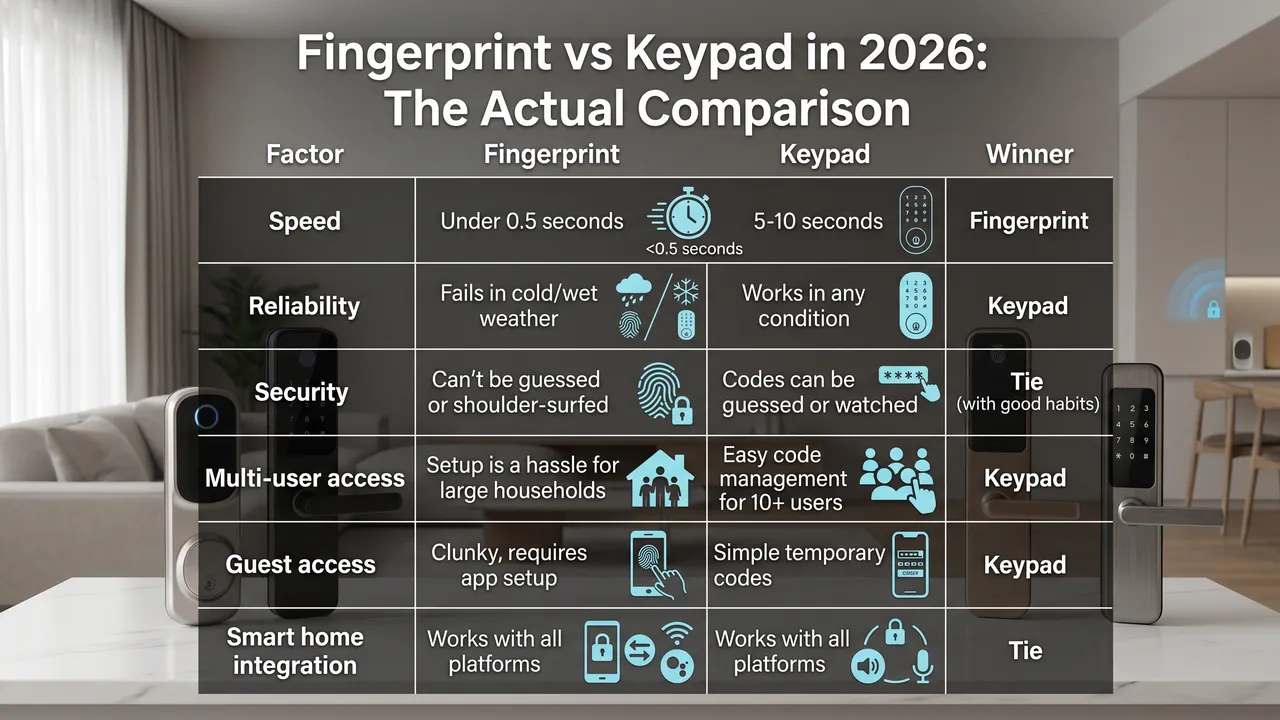
Fingerprint vs Keypad in 2026: The Actual Comparison
Here’s the real picture, based on extensive reading of reviews and user reports in 2026:
| Factor | Fingerprint | Keypad | Winner |
|---|---|---|---|
| Speed | Under 0.5 seconds | 5-10 seconds | Fingerprint |
| Reliability | Fails in cold/wet weather | Works in any condition | Keypad |
| Security | Can’t be guessed or shoulder-surfed | Codes can be guessed or watched | Tie (with good habits) |
| Multi-user access | Setup is a hassle for large households | Easy code management for 10+ users | Keypad |
| Guest access | Clunky, requires app setup | Simple temporary codes | Keypad |
| Smart home integration | Works with all platforms | Works with all platforms | Tie |
Speed: Fingerprint wins. Under 0.5 seconds on good locks versus 5-10 seconds to pull out your phone or type a code. But speed doesn’t matter if the fingerprint fails and you have to try three times.
Reliability: Keypad wins. Keypads work in any weather, with any hand condition, at any temperature. Fingerprint sensors all have failure modes, even the expensive ones.
Security: It’s a tie, with an asterisk. Fingerprint can’t be guessed or shoulder-surfed. Keypad codes can be both, but both problems are solvable with good habits.
Convenience for multiple users: Keypad wins. Managing 10 family members, each with their own code, is easy. Managing 10 family members with registered fingerprints is more of a setup hassle.
Guest access: Keypad wins. Temporary codes are simple. Temporary fingerprint access is clunky and often requires app-based setup.
Smart home integration: Tie. Both methods work with Matter, HomeKit, Alexa, and Google Home equally well in 2026.
The Case for Fingerprint: Why It Feels Like the Future

There’s nothing quite like walking up to your door and just… getting in. No fumbling for keys. No typing codes. Your finger is your key, and it’s always with you.
The technology has genuinely gotten better. Modern fingerprint sensors in locks like the Ultraloq Bolt Fingerprint unlock in under 0.5 seconds. Some locks now use AI that learns your fingerprint over time, getting faster and more accurate with every use.
From a security angle, fingerprints can’t be guessed the way a PIN code can. You can’t shoulder-surf a fingerprint.
The Fingerprint Problem Nobody Talks About
Here is where I stop being a fanboy and start being honest.
Cold weather is fingerprint lock enemy number one. Below 41 degrees Fahrenheit, cold air reduces blood flow to your fingertips, lowering skin temperature and diminishing the capacitance response the sensor needs.
Wet hands are almost as bad. Rain, hand cream, sweat, dishwashing.
Anything that changes the moisture or oil content on your skin surface can confuse even a good sensor. BTelec reports that hand cream alone can interfere with recognition if applied too thickly.
Worn fingerprints are a real issue for older users or people who work with their hands. The sensor relies on ridge patterns. If those ridges have worn down, the lock may simply not recognize you.
The result? You end up using the backup anyway. Which is fine until you forget the PIN, lose the key, or can’t reach your phone.
The Case for Keypad: Reliability You Can Count On
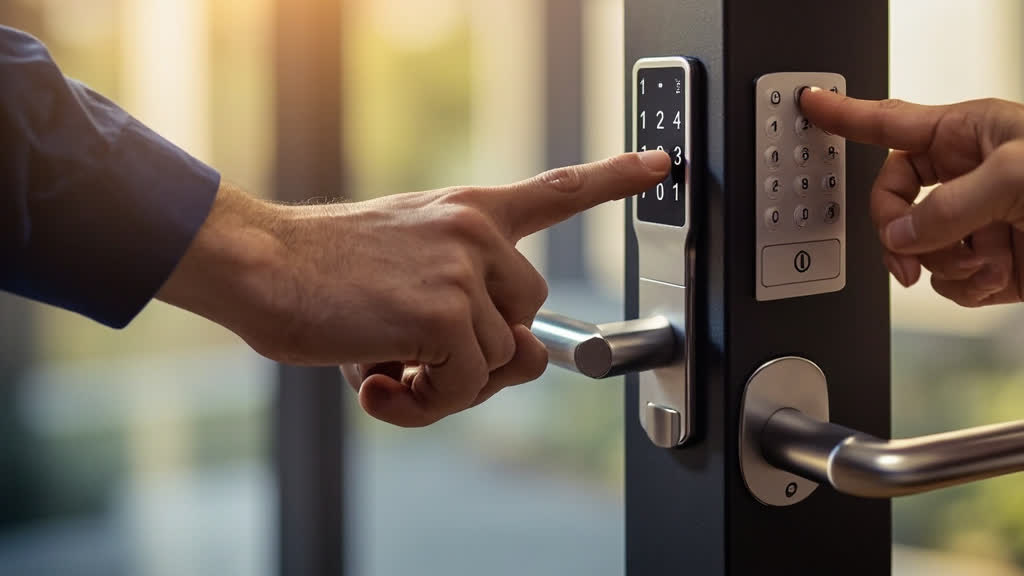
Keypads don’t care if it’s freezing. They don’t care if your hands are dry. They don’t care if you’re wearing thick gloves.
You type your code, the door opens. That’s it.
This is why keypad locks for cold climates are the most reliable day-to-day option. When the going gets cold, the fingerprint gets unreliable.
The security discussion around keypads is more nuanced than fingerprint fans admit. Yes, buttons wear out over time, and the most-used digits become visible through wear patterns. Commonly pressed buttons show wear, potentially helping someone guess your code over time.
But here’s what the fingerprint crowd misses: the solution is simple. Change your code regularly. Use random PIN patterns, not sequential or birthday-adjacent numbers.
Wipe down your keypad to avoid fingerprint residue revealing digits. These are behavioral habits, not lock flaws.
The Button Wear Problem Is Real, But Overstated
One Reddit homeowner pointed out the worn keypad problem in the context of regular non-smart keypad locks too. It’s not unique to smart locks. It’s a real issue that affects any keypad used frequently.
Modern flat touch keypads help significantly. They don’t have physically depressed buttons, so there’s no visible wear pattern. The entire surface is uniform, which means even after years of use, there’s nothing for a potential intruder to read.
The bigger keypad advantage in 2026? You can give temporary codes to people. Dog walker, house cleaner, visiting family.
You can set time-limited access. You can revoke it instantly without changing your own code.
Fingerprint locks don’t always make this easy, especially for people who aren’t already registered.
Who Actually Wins in 2026
After reading through all the evidence, here’s my honest answer.
Fingerprint wins if: You live in a moderate climate without harsh winters. You have healthy, unscarred fingerprints. You value convenience above all else.
Keypad wins if: You live somewhere with real winters. You have kids who can’t reliably use fingerprint sensors. You need to give access to cleaners, dog walkers, or guests regularly.
The reality is that most people should buy a lock with BOTH options. That’s not a cop-out. It’s the correct answer.
That is the smart play. The debate isn’t fingerprint versus keypad. It’s “which lock gives me both so I’m never stuck?”
The Real Winner: Locks With Both
The actual answer to “fingerprint vs keypad” in 2026 is: get a lock that has both.
The Ultraloq Bolt Fingerprint. The Aqara U100. The Eufy Smart Lock Touch. They all give you fingerprint, keypad, app control, and physical key backup.
A fingerprint-only lock in 2026 is a compromise you don’t need to make. The marginal price difference between a fingerprint-only lock and a dual-method lock is small.
My Take: This Debate Is Over
The question isn’t “which unlock method is better.” The question is “which lock gives me the most flexibility.”
Buy a lock with both.
Use fingerprint for daily convenience when conditions cooperate.
Use keypad when it’s cold, when your hands are wet, when you’re in a hurry and don’t want to miss the sensor.
The real winner in 2026 is the lock that doesn’t force you to choose.
