
Let me save you a headache. I made the mistake of buying smart home devices from three different ecosystems before I understood how they worked together.
I had an Alexa speaker, some Google Home bulbs, and a HomeKit camera. They didn’t talk to each other. It was a mess.
If you are starting fresh in 2026, do not do what I did. Pick your ecosystem first. Then buy your devices. That one decision will determine how easy your smart home is to use for years to come.
Here is my honest breakdown of the three big players.
The Three Big Players in 2026
You have three main choices. Amazon Alexa, Google Home, and Apple HomeKit. Each one has a different philosophy. Each one is best for different types of people.
Here is the quick comparison.
| Feature | Apple HomeKit | Google Home | Amazon Alexa |
|---|---|---|---|
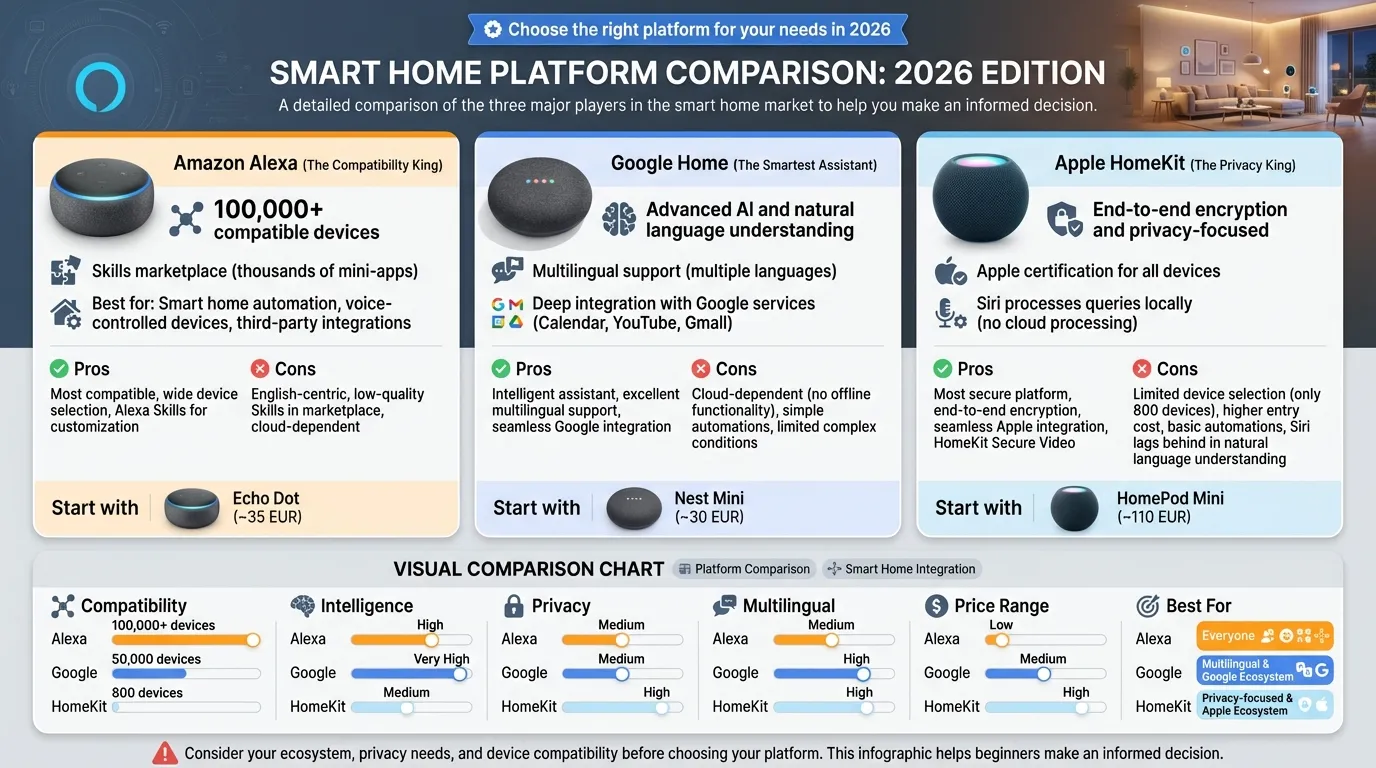
| Compatible Devices | ~800+ | 50,000+ | 100,000+ |
| Entry Cost | From 110 EUR | From 30 EUR | From 35 EUR |
| Voice Assistant | Siri | Google Assistant | Alexa |
| Matter Support | Full | Full | Full |
| Best For | Privacy and Apple users | AI and multilingual | Compatibility and Skills |
Amazon Alexa: The Compatibility King
Alexa has the most compatible devices. Over 100,000 products work with Alexa. That is a big number. If you walk into any electronics store, the Alexa logo is on almost everything.
What I like about Alexa is the Skills. Third-party developers have created thousands of mini-apps called Skills.
Want to order pizza with your voice? There is a Skill for that. Want to play trivia games? Alexa has hundreds. You can make your smart home do almost anything.
Alexa Plus dropped in 2026 with AI personalization. It learns your habits and suggests automations. Pretty handy. The Echo Show with a screen is great for video calls and seeing your security cameras.
The downside? Alexa is primarily English-centric. If you need multilingual support, Google is better. Also, the Skills marketplace has a lot of low-quality Skills. It takes time to find the good ones.
Start with an Echo Dot for about 35 EUR.
Google Home: The Smartest Assistant
Google Home wins on intelligence.
Google Assistant understands complex questions. It handles follow-up queries without you repeating context. If you ask “What is the weather?” and then say “Will I need an umbrella?”, Google knows you are still talking about the weather.
The multilingual support is excellent.
If your household speaks multiple languages, Google Home handles that seamlessly. It works in way more languages than Alexa or Siri.
Deep integration with Google Calendar, YouTube, and Gmail makes it powerful if you already live in Google’s world. The Nest Hub with a screen is my favorite dashboard for controlling your smart home.
The downside? Google Home is cloud-dependent. Without the internet, nothing works. The automations are simple. You get one trigger followed by actions. Nothing too complex.
Start with a Nest Mini for about 30 EUR.
Apple HomeKit: The Privacy King
HomeKit is the most secure platform.
Every device must pass Apple certification before it can be sold. Your data is encrypted end-to-end. Siri processes many queries locally on your device without sending them to the cloud. This matters a lot if privacy is your thing.
If you already own an iPhone, iPad, Mac, and Apple Watch, HomeKit feels seamless. The Home app is beautiful. HomeKit Secure Video stores your camera footage in iCloud without Apple being able to see it.
The downside? Compatible device selection is tiny compared to the others. About 800 devices versus 100,000 for Alexa. That limits your options. The entry cost is higher, too. A HomePod Mini starts at 110 EUR. You also need an Apple TV or HomePod as a hub for remote access.
Siri lags behind Google Assistant in understanding natural language. The automations are basic. You get simple triggers only. No complex conditions or variables.
The Game Changer: Matter Protocol
Matter changed everything in 2026. It launched in 2024 as a unified protocol. A Matter-certified device works with HomeKit, Google Home, AND Alexa simultaneously.
That means you are no longer locked into one ecosystem. Buy a Matter smart bulb. It works with all three platforms. You can switch voice assistants anytime without replacing your hardware.
Most new devices support Matter natively now. This includes bulbs, plugs, locks, and thermostats. Platform compatibility is much less important now. The best strategy is to pick your voice assistant and buy Matter devices.
My Recommendation for Beginners
After trying all three, here is what I tell friends.
If you want the easiest experience with the best AI: Go with Google Home. Setup is simple. The assistant is smart. The entry cost is low at 30 EUR.
If you want the most device options and third-party integrations: Go with Alexa. You will never run out of things to add. The Echo devices are affordable.
If you already live in the Apple ecosystem and privacy is your priority: Go with HomeKit. Just know you will have fewer device choices and pay more.
The smart strategy in 2026: Pick your voice assistant based on what feels natural to you. Then buy only Matter-certified devices. That way, you keep flexibility for the future.
I went with Google Home because I use Calendar and Gmail every day. The AI just works better for my needs. What matters most to you?