

Everything I wish I knew before buying my first smart lights
—
I stood in the lighting aisle two years ago, staring at boxes labeled “Matter-enabled.” I just wanted to dim my bedroom without getting up. That confusion cost me $200 and a frustrated girlfriend.
Don’t make the same mistakes.
The smart lighting market is projected to grow from $27.52 billion in 2026 to $67.83 billion by 2031. That’s a 19.77% CAGR. Everyone is jumping in. Starting wrong means wasting money and giving up.
What Is Smart Lighting Actually?
Smart lighting lets you control lights from your phone or voice. No more climbing out of bed to dim the lights. You can change colors, set schedules, and simulate sunrise.
2026 is different because of Matter protocol.
This makes different brands work together. You can mix Philips Hue with IKEA or Nanoleaf without headaches.
If you avoided smart lighting because of brand lock-in fears, 2026 changes that.
Smart Bulbs vs Smart Switches: The First Choice
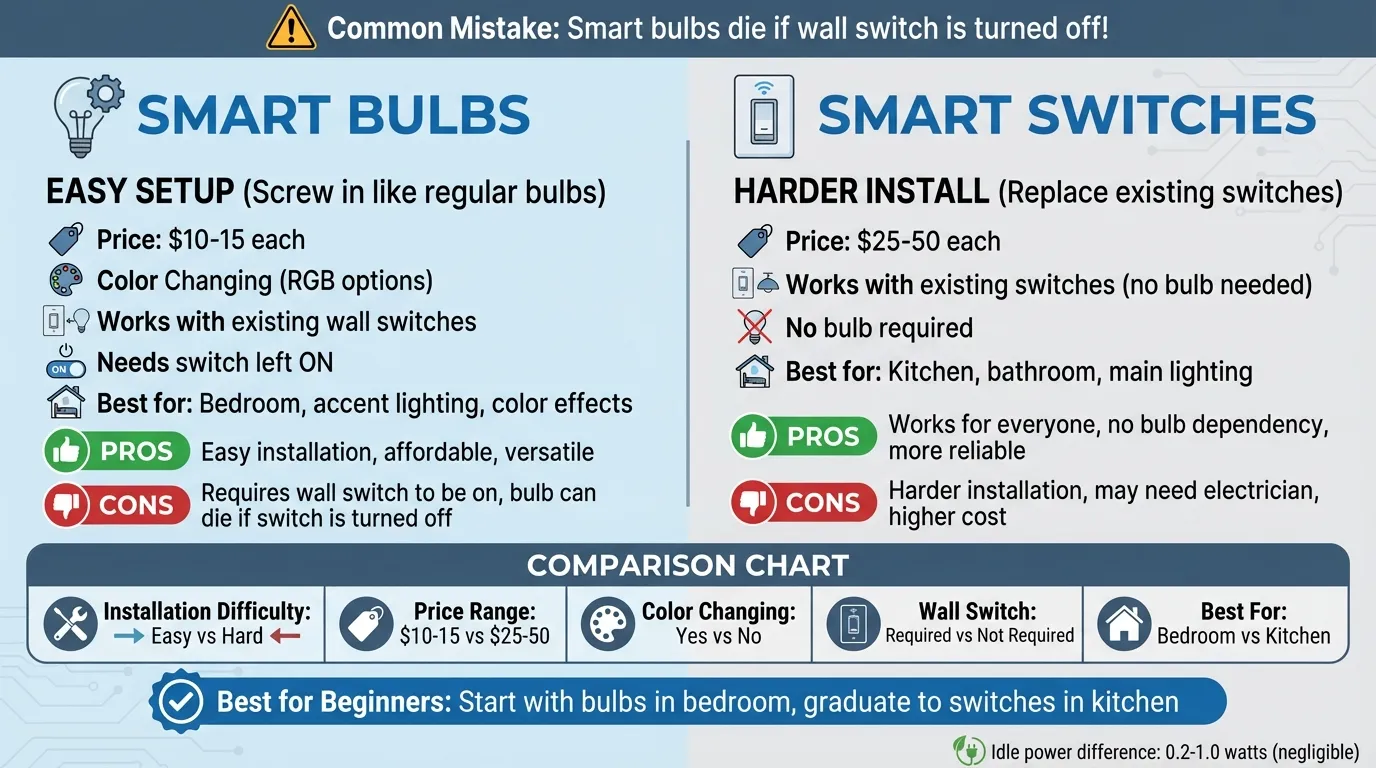
Most beginners fail here. I bought smart bulbs. My girlfriend turned off the wall switch like always. The bulb died. She said, “Your smart lights are stupid.”
You have two paths.
Smart bulbs screw in like regular bulbs. They’re great for colors and easy setup. But someone must leave the wall switch on.
Smart switches replace your existing switches. They work for everyone. The trade-off is harder installation. You might need an electrician.
Here’s the comparison:
- Smart Bulbs: Easy setup, $10-15 each, color changing, needs switch left on
- Smart Switches: Harder install, $25-50 each, works with existing switches, no bulb needed
- Best for Beginners: Start with bulbs in bedroom, graduate to switches in kitchen
The idle power difference is tiny. Reddit users report just 0.2-1.0 watts difference. Don’t let that stop you.
What You Actually Need to Start
You need less than you think. A hub is optional. Philips Hue requires one. But Matter-compatible bulbs from Nanoleaf or TP-Link need no hub. Two to three starter bulbs let you test the waters. Pick one room where dimmable lighting would help.
A smart speaker acts as your voice controller. An Echo, Google Nest, or Apple HomePod lets you say “Hey Google, dim to 50%” and have it work. In 2026, this is seamless with Matter devices.
You can start for under $50. That’s two Matter bulbs plus you probably already have a smart speaker.
Mistakes I Made So You Don’t Have To
First, don’t overcomplicate naming. Reddit users joke that naming lights is the hardest part. I named mine “Bedroom Ceiling” and “Bedroom Lamp.” Keep it simple.
Second, don’t buy everything at once. I ordered seven different brands. Result? Three apps on my phone. Pick one ecosystem. Stick with it for six months. Then expand.
Third, watch for flickering. Several Reddit users reported problems with off-brand bulbs. Stick to quality brands. Philips Hue, LIFX, Nanoleaf, and TP-Link have better quality control than cheap Amazon options.
Making It Work for Your Whole Household
This is the real test. Smart lighting must work for people who don’t care about technology. My girlfriend doesn’t want to open an app. She wants lights to work when she walks in.
The solution was smart switches with motion sensors. Now when she walks into the kitchen, lights turn on automatically. When she leaves, they turn off after two minutes. No app required.
For bedrooms, set up one-tap scenes. “Movie Night” dims to 20% with warm amber. “Reading” boosts to 80% with cool white. These take 30 seconds to set up and get used every day.
Why 2026 Is the Year to Start
Here’s why this year is different. Matter protocol has finally matured. ‘
What started as a confusing mess is now a unified system. I can take a Matter bulb from one brand and control it from a different app. That wasn’t possible two years ago.
Pricing has come down significantly. Quality smart bulbs that cost $25 are now $10-15. Smart switches that needed pros now have easy DIY options.
Your First Week Action Plan
Day one: buy two Matter-compatible bulbs and a smart speaker if you don’t have one.
Day two: install in one room and play with the app.
Day three: set up your first routine like movie night or morning wake-up.
Day four: add a voice command.
Day five: show your family and let them try it.
By the end of a week, you’ll know if smart lighting works for you.
The future of lighting is smart. And in 2026, it’s finally easy enough for anyone to start.