
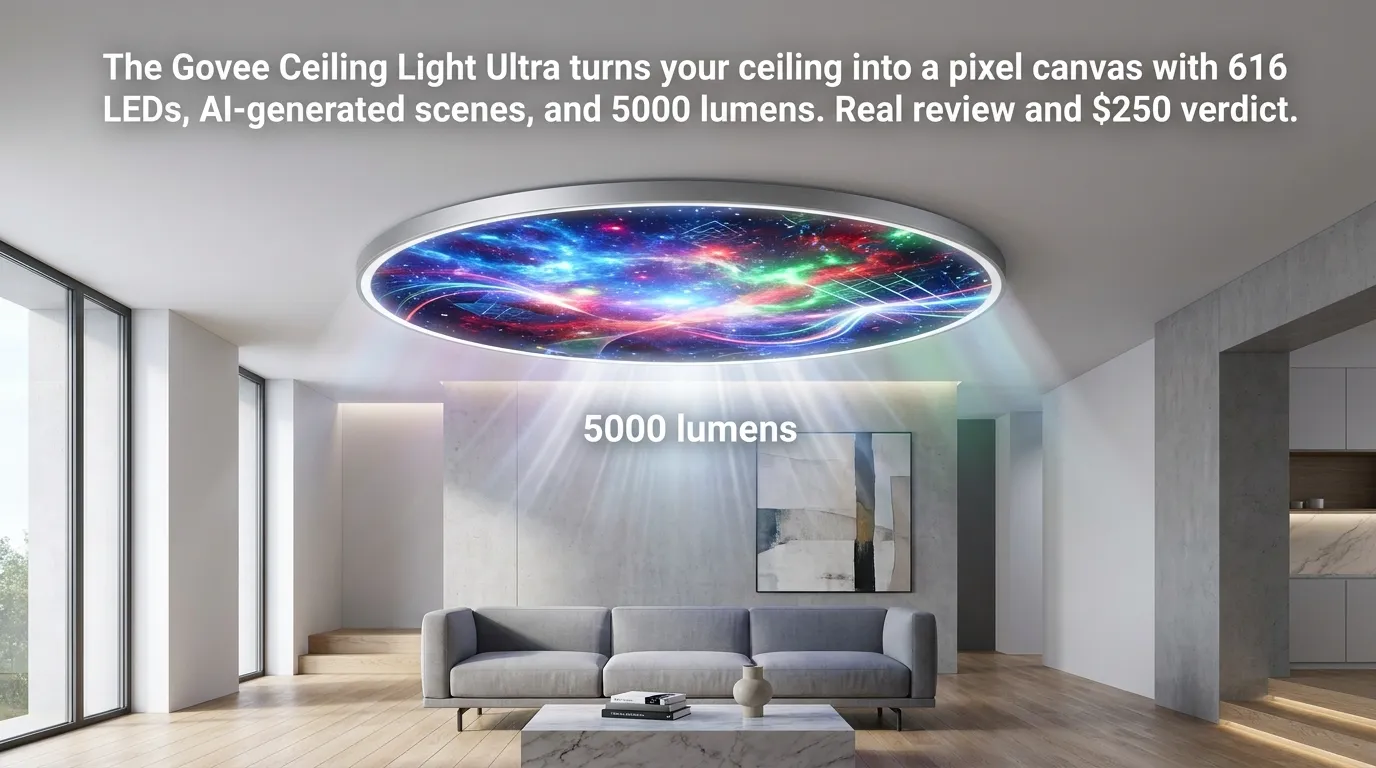
Last night, I watched a meteor shower. On my ceiling. In my apartment. No, I was not lying on the floor staring out a window. I was looking up at a Govee Ceiling Light Ultra.
The light was running a dark blue animation. Tiny white pixels pulsed across the surface like stars.
This is what Govee is promising with the Ceiling Light Ultra.
It launched on April 27, 2026. It does something no other ceiling light on the market can. It turns your ceiling into a pixel-level LED canvas.
What Exactly Is the Govee Ceiling Light Ultra?
At its core, this is a 21-inch disk-shaped ceiling fixture. But calling it just a ceiling light is like calling a smartphone just a phone.
The Ceiling Light Ultra packs 616 ultra-dense, independently controlled LEDs into a screen-grade matrix layout. That density is what makes the difference.
Each pixel can display a different color or brightness level simultaneously. The result is not a glowing ceiling. It is a ceiling that can show actual imagery, animations, and atmospheric scenes.
The specs back it up. Up to 5000 lumens of brightness. A CRI of 95 for color accuracy.
Adjustable color temperature from 2700K to 6500K. It shifts from warm evening light to cool daylight on command. As a pure light source, it is more than capable of lighting a room up to 30 square meters.
But the magic is in what happens when you switch off the practical light mode.
Pixel Art on the Ceiling Is Weirdly Compelling
A Reddit user on r/Lighting put it simply:
“Instead of just another boring ceiling fixture, it packs 616 LEDs into a matrix that can actually display patterns and animations overhead, which is pretty wild.”
That is exactly right. “Wild” is the right word.
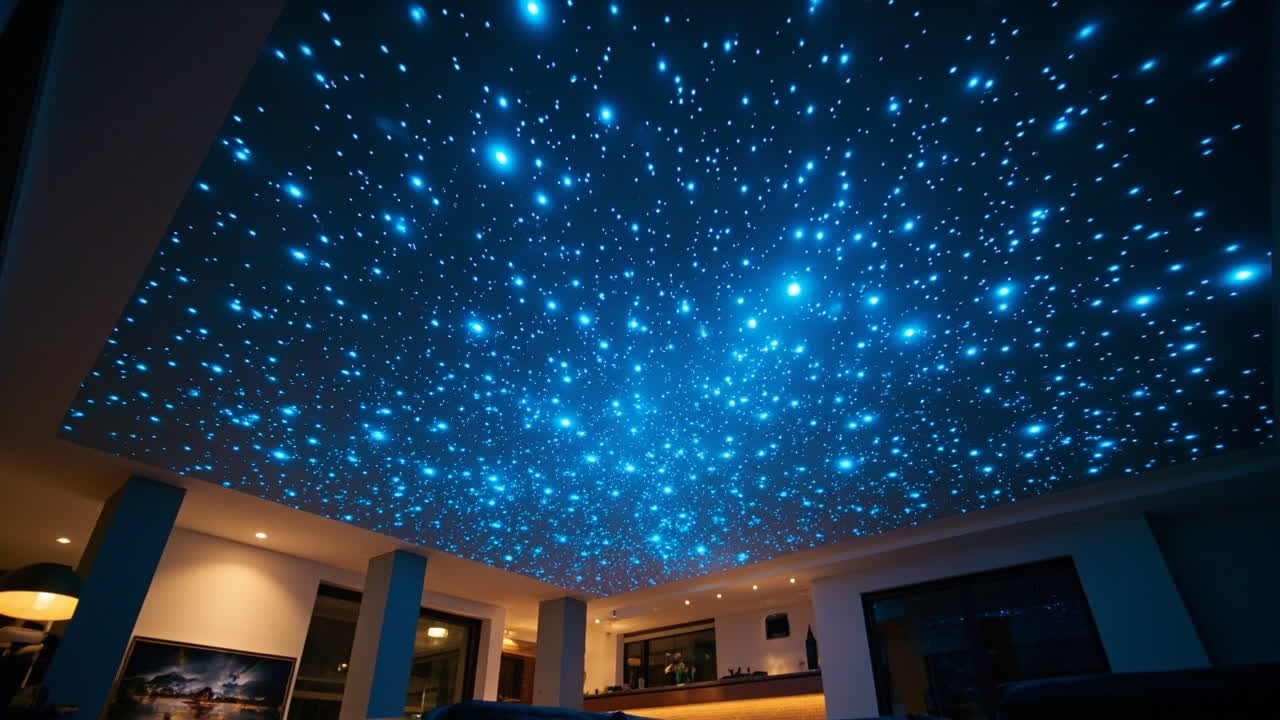
The 616-LED matrix can display figurative lighting effects. Think aurora borealis greens, a sunset gradient, pixel art clouds, or an animated starfield.
The resolution is low enough that it has a retro, artsy feel. It is not trying to be a screen. It is something else.
According to The Verge, the 616 color-changing LEDs create “dynamic mood lighting or to display pixelated images.” That dual personality is the selling point. During the day, it is a powerful, tunable ceiling light. At night, it becomes an ambient canvas.
AI Lighting Bot 2.0: Type a Scene, Get a Sky
Govee’s AI Lighting Bot 2.0 is what makes this accessible. You are not stuck with preset animations. You can type something like “northern lights over a dark sky” or “rain on a window” and the system generates an animated lighting scene that plays on your ceiling.
The AI is not a gimmick here. It is the creative engine that makes the ceiling genuinely useful as an ambient display rather than just a tech demo.
There is also a DaySync mode that adjusts the light based on the time of day, and standard DIY tools for creating pixel-level designs or uploading your own images.
What Can You Actually Do With It?
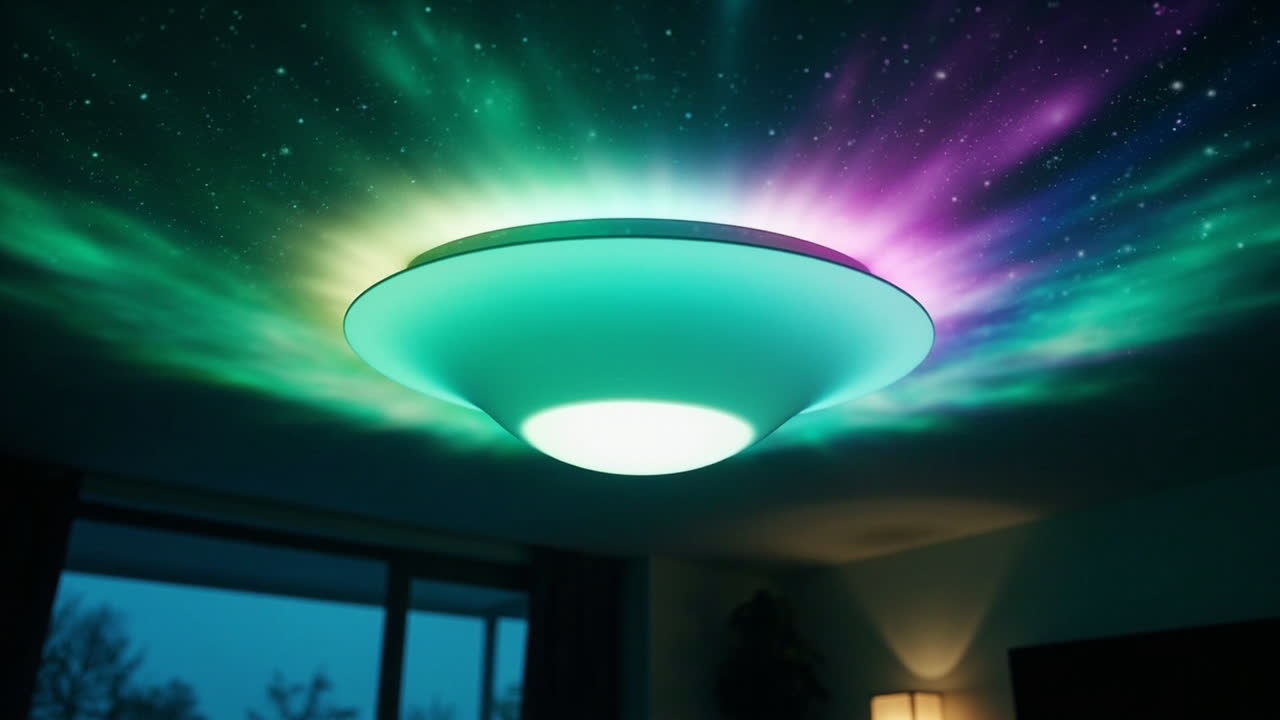
Here is where the ceiling becomes a canvas in practical terms.
Gaming rooms. A dark room with an aurora borealis effect overhead transforms a gaming setup from “nice” to “atmospheric.” One animation running overhead can completely change how a room feels.
Movie nights. Pair it with a smart bulb behind the TV for bias lighting, and you now have full-room ambient lighting synced to content. Some users noted on Reddit that the effect works particularly well in dark rooms with high ceilings.
Kids’ rooms. A soft animated night sky in blue and white, with the option to switch to bright rainbow patterns for playtime. No need for glow-in-the-dark stickers that lose their effect after a week.
Meditation or relaxation. A slow-moving warm gradient, low brightness, soft color temperature. The room becomes a sensory space without buying a separate light projector.
How Does It Compare to Philips Hue?
The natural question is how it compares to Philips Hue.
Hue is the gold standard for smart lighting. Their ecosystem is mature, the app is reliable, and the color quality is excellent. But Hue does not make anything like the Ceiling Light Ultra.
Hue has light strips, bulbs, spotlights, and gradient bars. No ceiling fixture that can display pixel-level imagery.
CNET also noted that Philips Hue has no comparable type of lighting solution. That is the honest truth. If you want ceiling pixel art, Hue cannot give it to you.
Some Reddit users who have tried both flagged app reliability as a concern with Govee. One user said “Govee’s app is so cumbersome, a pain in the ahh for the simplest things.”
That is worth noting. Govee has historically lagged behind Hue in app polish and reliability. Whether that has improved with the Ceiling Light Ultra is something hands-on testing will reveal over time.
Matter Support and Ecosystem Integration
The Ceiling Light Ultra works with Matter, Amazon Alexa, Google Home, and Samsung SmartThings. This matters because it is not locked into the Govee app ecosystem. If you run a multi-brand smart home, you can add this to your existing setup without friction.
The Matter Alpha outlet described it as “a Matter-enabled fixture that turns your ceiling into an AI-powered pixel canvas.”
That is a fair summary.
The AI generation happens in Govee’s app, but once a scene is active, standard Matter controls let you adjust brightness or switch scenes through any major smart home platform.
Is It Worth $250?
Here is my take. If you have a room where lighting is part of the experience, this is worth considering.
A home theater room. A gaming space. A bedroom where you want actual ambience rather than just illumination.
At $250, it is not cheap. But compared to buying a premium ceiling light ($80-150) plus an LED matrix strip ($80-120) plus smart bulbs ($60-100), it is not wildly out of line for what you are getting.
The honest answer is that this is a niche product for people who already care about home ambience. If you are the type who has biased lighting behind your TV and thinks about how a room feels at night, the Ceiling Light Ultra makes sense. If you just want a bright ceiling light, there are cheaper options.
What Govee has built is genuinely new. The ceiling as a pixel canvas is not a concept. It is shipping now.
Whether you want one is a matter of whether your ceiling is ready to become the show.
