
I’ve been living in a smart home for over 8 years. Without a smart hub, your devices will frustrate you. Lights lag, and devices won’t talk to each other.
That’s the brutal truth. But here’s the good news: 2026 is actually a great time to finally get a hub. Matter is mature now, setup is easier, and prices are reasonable.
What Even Is a Smart Hub?
A smart home hub is the brain of your setup. It’s the translator between devices. Most hubs look like a small puck you plug into your router.
Smart hubs connect via Zigbee, Z-Wave, and Thread. These protocols use mesh networks. More devices actually mean stronger connections.
According to The Verge, a smart hub
“provides one central place to send commands to multiple devices so that you now only need to use its one app to manage all of your gadgets and routines.”
The Two Types of Hubs
Multi-protocol hubs are flexible. Aeotec and SmartThings fall into this category. They work with multiple platforms, but can feel complicated to set up.
Ecosystem hubs are simpler. Echo, Google Home, and Apple HomePod are the main players. They tie you into a single ecosystem, but are much easier for beginners.
With Matter rolling out in 2026, the lines between these are getting blurry anyway.
Popular Hubs for Beginners in 2026
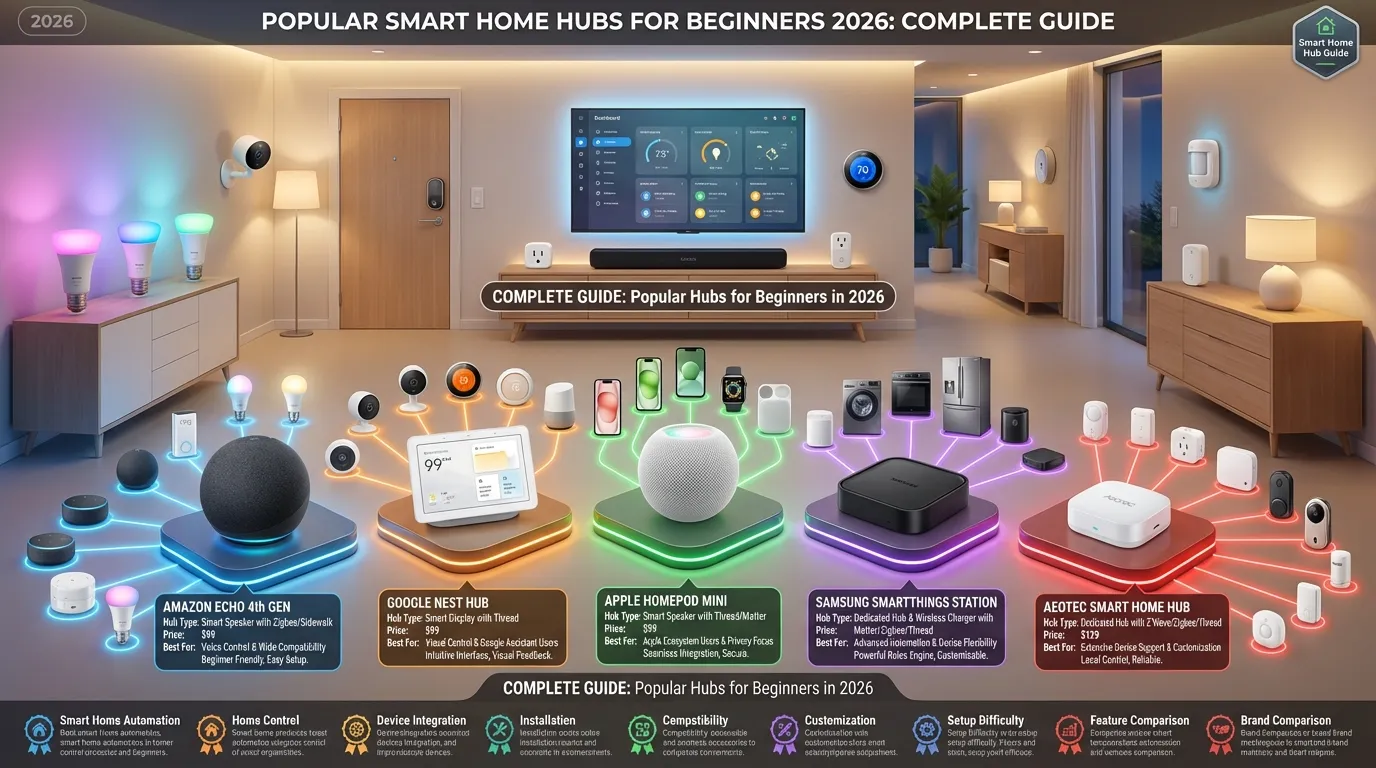
| Hub | Type | Price | Best For |
|---|---|---|---|
| Amazon Echo (4th Gen) | Ecosystem | $100 | Alexa users, beginners |
| Google Nest Hub | Ecosystem | $90 | Google Home users |
| Apple HomePod Mini | Ecosystem | $99 | Apple ecosystem fans |
| Samsung SmartThings Station | Multi-protocol | $50 | Budget-friendly, flexible |
| Aeotec Smart Home Hub | Multi-protocol | $120 | Advanced users |
ZDNET recommends the Echo Dot or Nest Mini as budget options under $50. They’re often on sale and give you voice control plus basic hub features.
NBC News tested the most popular hubs in 2026. Their editors picked favorites for Google, Amazon, and Apple ecosystems.
Why You Probably Do Need One
If you only have a couple of smart lights, you might be fine. But once you hit 5+ devices from different brands? Things get messy fast.
Local control is the biggest perk. Your automations keep working even when the internet goes down. The Verge notes that local control also keeps your data more secure.
No more app clutter. One app instead of five.
According to PCMag, smart home hubs are
“a one-stop solution for unifying your connected gadgets and controlling them from one app, instead of many.”
TechTarget explains that a hub
“connects devices on a home automation network and controls communications among them.” It’s the central nervous system of your smart home.
Matter is Changing Everything in 2026
If you’ve been waiting to jump in, now’s a great time. Matter, the universal standard backed by Apple, Google, Amazon, and Samsung, is finally mature.
CSA-IOT reports that Matter creates a unifying protocol. It helps devices work together across ecosystems.
SafeWise chose Aeotec as the best smart hub in 2026. They praised its
“top-tier compatibility and powerful automation features.”
Matter 1.4 brings even more features. The Houston Chronicle reports that you can now
“keep control via Siri when internet goes out.”
That’s huge for reliability.
Get a hub that’s both a Matter controller and a Thread border router. This combo future-proofs your setup.
What About Z-Wave and Zigbee?
If you’re wondering about older protocols, here’s the deal. Zigbee and Z-Wave still work great. They’re not going anywhere anytime soon.
Homey explains that a hub
“unifies the different devices in your home into a single system.”
This includes legacy devices that don’t support Matter yet.
If you have older Z-Wave locks or Zigbee sensors, get a hub that supports both. SmartThings Station handles Zigbee. Aeotec handles both.
So… Do You Need One?
Yes, if:
- You have more than 5 smart devices
- Your devices are from different brands
- You want automations that work when the internet is down
- You’re tired of jumping between apps
Maybe not, if:
- You only have 1-2 smart devices
- You’re okay with cloud-only control
- You’re just testing the waters
The Bottom Line
A smart hub isn’t required for everyone. But if you’re serious about building a real smart home, it’s worth the investment.
Start with something simple like an Echo Dot or Nest Mini. Just make sure whatever you pick supports Matter and Thread.
The future of smart homes is local, interoperable, and way less frustrating than the old days.
Whether you’re just starting out or expanding an existing setup, a hub makes everything run more smoothly. The initial setup takes maybe 15 minutes. After that, your smart home actually feels smart.
Trust me, I’ve been there. The difference between a hubbed setup and a hub-less one is night and day.